

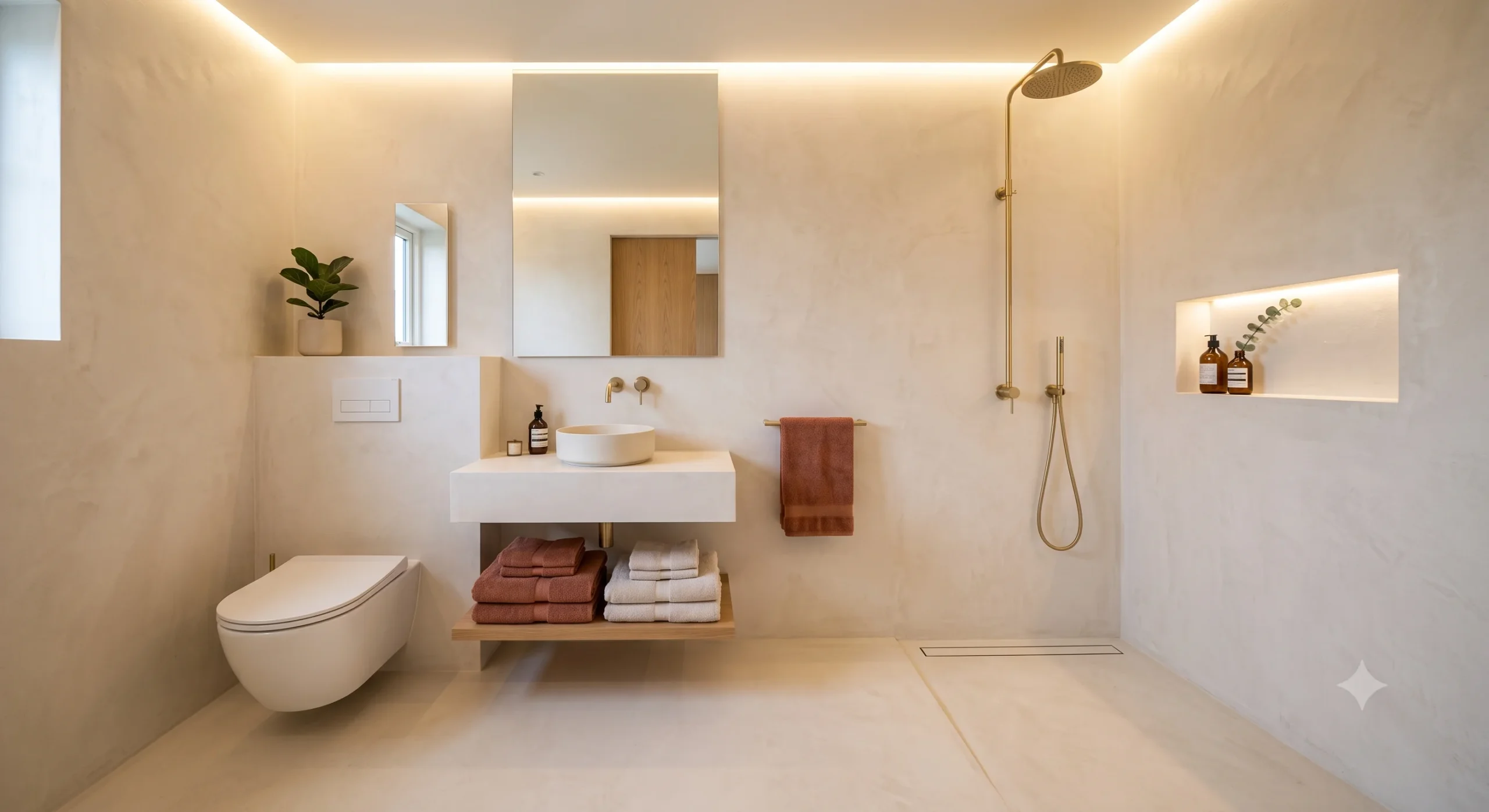
When you are dealing with a truly restrictive floor plan, traditional bathroom design rules quickly fall apart. Squeezing a bulky shower enclosure or a standard bathtub into a tiny en-suite often leaves you with a cramped space. Fortunately, exploring very small wet room ideas opens up a world of clever architectural solutions. These setups remove physical boundaries and maximize your available square footage.
Consequently, treating the entire room as a waterproof showering zone eliminates the need for restrictive trays. This comprehensive guide explores the best walk-in shower styles, high-impact space-saving hacks, and visual tricks. Ultimately, these methods transform compact bathroom designs into open, spa-like sanctuaries.
1. The Reality of Micro Wet Rooms: What is the Smallest Size Needed?
Homeowners frequently ask a vital question when planning a compact bathroom revamp. Specifically, they want to know what is the smallest size needed for a wet room. While standard design guides recommend a larger footprint, the practical reality is much more encouraging. Indeed, you can implement successful very small wet room ideas in spaces as tight as a 1m x 1m wet room layout.
Therefore, these micro wet room ideas are particularly useful for a small ensuite wet room conversion. They also work brilliantly for an under-stairs cupboard transformation. However, you must map out clear clearance zones to make a micro layout function without feeling suffocated. In an ultra-compact space, the entire floor area becomes part of the splash zone. As a result, the distance between your fixtures must be calculated down to the millimeter.
Furthermore, removing the raised shower tray automatically gains you valuable floor area. Consequently, navigating a tiny room safely and comfortably becomes much easier.
2. Space-Saving Layout Frameworks (The Floating Philosophy)
Reclaiming Footprint with Short-Projection, Wall-Mounted Fixtures
To make a small bathroom wet room look expansive, you need to keep the floor visible. This is where the floating philosophy plays a massive role. For example, trading traditional floor-standing vanities for wall-mounted fixtures instantly tricks the brain. Your eyes perceive significantly more room because the floor remains clear. Similarly, a wall-hung toilet paired with a short-projection washbasin keeps the floor tile completely continuous. By freeing up the ground level, you make the room much easier to clean. Meanwhile, you successfully remove the visual clutter that disrupts the flow of a tight space.
Eliminating Swing Space: The Pocket Door vs. Bifold Glass Screen
In tight layouts, standard doors that swing inward can ruin your usable footprint. A brilliant way to address this problem is by installing a sliding pocket door. This door disappears entirely into the wall cavity when opened. Thus, this simple architectural change reclaims up to one square meter of floor space.
Additionally, consider using a folding shower screen or a bifold wet room screen within the showering zone. These flexible glass panels pin completely flat against the wall when the shower is not in use. As a result, they instantly open up the room for your daily morning routines.
Utilizing Recessed Wall Niches to Replace Clunky Shelving
When square footage is tight, protruding storage units can feel like physical obstacles. Therefore, you should avoid hanging bulky shelves. Instead, carve out recessed shower niches directly into the stud walls before tanking the room. These integrated cubbies sit completely flush with your wall surfaces. Consequently, they provide sleek storage for your luxury bathroom materials without stealing an inch of physical space.
3. The Nordic & Scandi Aesthetic: Visual Expansion for Tiny Footprints
Microcement Walls vs. Large-Format Porcelain: Eradicating Grout Lines
To create a seamless look, turn to a Scandi-style small wet room aesthetic. A minimalist Nordic lifestyle focuses heavily on clean lines and a total lack of clutter. You can achieve this visually by minimizing or completely eliminating your grout lines. For instance, traditional subway tiles create a busy grid pattern every few inches.
In contrast, choosing a completely seamless waterproof microcement wet room wall solves this issue entirely. Alternatively, utilizing massive large-format porcelain tiles dramatically reduces the number of joints. Either way, removing the visual grid pattern prevents tight walls from feeling enclosed.
Monochromatic Color Drenching: Using Earthy Terrakotta and Off-White Tones
While historical design tips always suggest stark white for tiny rooms, modern design trends have evolved. Today, modern Nordic minimalist wetroom trends lean heavily toward monochromatic color drenching. This technique involves finishing the walls, ceiling, and floor in cohesive, closely related shades. For example, utilizing warm, muted earthy tones like terracotta or warm off-white creates a deeply cocooned environment. Because the human eye cannot easily define where the floor ends, the room naturally feels larger.
Embracing Curves: Softening Hard Edges in a Cocooned Alcove Shower
If your architectural layout permits, creating a gently curved showering area is an exceptional choice. A cocooned alcove shower offers a welcoming relief to the rigid lines found in standard bathroom furniture packs. Moreover, tiling a soft arc with vertical mosaic strips guides the eye upward. This clever direction accentuates the ceiling height and effectively distracts from a tight horizontal footprint.
4. The Optical Illusion Checklist: Lighting Hacks for Windowless Spaces
Because many compact en-suites in the UK lack windows, smart artificial lighting is an absolute necessity. You can use light strategically to push back your wall boundaries. First, look at diffused LED perimeter lighting. Installing waterproof, flush-mounted LED strips along the top ceiling perimeter washes the walls in light. As a result, it creates the illusion that the walls are being pushed outward.
Next, evaluate your glass choices. If you choose to install wet room screens to protect certain dry zones, select a backlit fluted glass panel. The texture of fluted glass beautifully distorts light. Therefore, brightness travels through the space while maintaining total privacy. Finally, add illumination to your recessed storage niches. Doing this adds deep layers of light, which break up flat wall surfaces and provide architectural depth.
5. Technical Water Management in Tight Zones
Why a Linear Wet Room Drain Outperforms Traditional Square Drains
When gathering practical data for very small wet room ideas, technical execution must be your top priority. In tight quarters, traditional central square drains can be highly problematic. This issue occurs because they require the floor tiles to be cut at multiple awkward angles. Conversely, a linear wet room drain is vastly superior for a micro space. This preference exists because a linear drain only requires a simple, single-direction slope toward the wall. Consequently, this allows you to use beautiful, large-format tiles without complex cuts, maintaining that critical seamless look.
Creating a Flawless Floor Gradient Drop Without Tripping Hazards
To ensure water flows directly down the waste hole, your contractor must create a precise floor gradient. Usually, a standard slope of 1:80 is the ideal target for safety and drainage. This subtle incline effectively moves water away from your wet and dry zones. Furthermore, it achieves this goal without creating an awkward step or a tripping hazard at the doorway.
6. Real UK Cost & Investment Guide
Embarking on a wet room installation is a serious renovation project. Thus, understanding the financial reality is essential for your planning. Homeowners often ask how much it does cost to put in a wet room. For a very small space in the UK, a professional installation typically ranges between £5,000 and £9,500.
Naturally, this price variance depends heavily on your choice of materials and the complexity of your plumbing. It also depends on the structural preparation required for waterproofing the room. For instance, professional tanking generally costs between £800 and £1,500. Meanwhile, specialist plumbing and a linear drain can add £1,200 to £2,200 to the budget. High-end tiling or microcement finishes typically require an additional £1,500 to £3,000. Finally, sanitaryware and fixtures fill out the remaining £1,000 to £2,500.
However, despite the upfront cost, it remains a highly desirable feature for properties. It significantly increases your home’s attractiveness to potential buyers. Real estate experts frequently recommend a wet room conversion for secondary bathrooms. Ultimately, it adds significant premium value to a home.
Summary Checklist:
As you finalize your plans, keep this quick summary checklist in mind. It ensures your project combines technical safety with breathtaking design:
-
Maximize Floor Visibility: Use wall-hung sanitaryware exclusively.
-
Eliminate Door Constraints: Install a pocket door or a folding frameless screen.
-
Streamline Surfaces: Select large-format tiles or microcement to drop grout line clutter.
-
Prioritize Linear Drainage: Choose a wall-aligned linear drain for effortless water flow.
-
Inject Warmth: Layer diffused perimeter lighting and rich, monochromatic tones.
Ultimately, implementing these specialized very small wet room ideas ensures that your micro bathroom works incredibly hard. It proves that a lack of square footage never has to limit your design aspirations.



Leave a Reply