

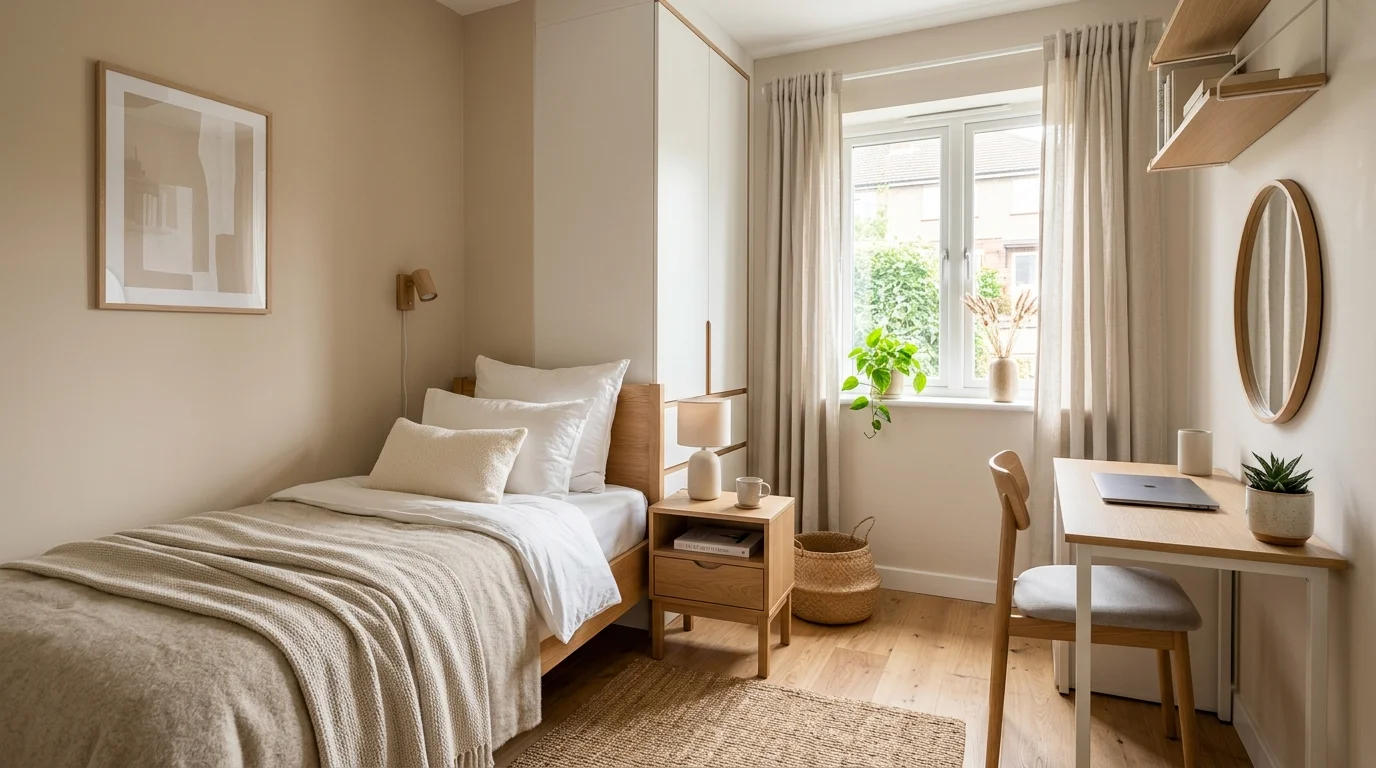
Choosing the right size for a single bedroom is not only about fitting a bed into the room. A bedroom can hold a single bed and still feel cramped if there is no space for walking, storage, wardrobe access, desk use, or door movement. That is why understanding the standard single bedroom size matters before designing, renovating, renting, furnishing, or planning a small room.
In most homes, a practical single bedroom sits between 7.5 and 10 square meters, or around 80 to 108 square feet. However, the best size depends on how the room will be used. For example, a child’s room may need space for toys and storage, while a student’s room may need a desk, chair, shelves, and charging points.
A good single bedroom should feel usable, not just measurable. Therefore, the goal is to plan around the bed, furniture, movement space, and storage together. This guide explains minimum single bedroom size, ideal single bedroom dimensions, room size in feet and meters, single bed size, furniture clearance, layout examples, and small bedroom design tips.
What Size Should a Single Bedroom Be?
The standard single bedroom size is usually around 7.5 to 10 square meters, or 80 to 108 square feet. A room around 7.5 square meters can work as a minimum single bedroom, while 8 to 10 square meters is more comfortable for everyday use.
For a simple example, an 8 × 10 ft room gives about 80 square feet. This size can fit a single bed, a compact wardrobe, and a small bedside table if the layout is planned well. However, if the room also needs a desk, drawers, and better walking space, a 9 × 10 ft or 10 × 10 ft room will usually feel much better.
| Room Type | Approx. Size in Feet | Approx. Size in Meters | Area | Best Use |
|---|---|---|---|---|
| Very tight single room | 7 × 10 ft | 2.1 × 3 m | 70 sq ft / 6.5 m² | Bed only or very minimal furniture |
| Minimum single bedroom | 7 × 11.5 ft | 2.15 × 3.5 m | 80.7 sq ft / 7.5 m² | Single bed with basic storage |
| Small single bedroom | 8 × 10 ft | 2.4 × 3 m | 80 sq ft / 7.4 m² | Single bed and compact wardrobe |
| Comfortable single bedroom | 9 × 10 ft | 2.7 × 3 m | 90 sq ft / 8.4 m² | Bed, wardrobe and small desk |
| Ideal single bedroom | 10 × 10 ft | 3 × 3 m | 100 sq ft / 9.3 m² | Bed, wardrobe, desk and drawers |
| Spacious single bedroom | 10 × 12 ft | 3 × 3.6 m | 120 sq ft / 11.1 m² | Full furniture layout with better clearance |
Overall, floor area is important, but room shape matters just as much. A narrow room may have enough square footage on paper, yet it can still be difficult to furnish properly.
Single Bedroom Size vs Single Bed Size
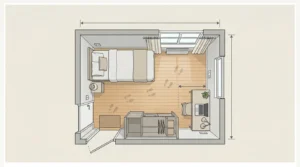
Many people confuse single bedroom size with single bed size. However, they are not the same thing. Single bedroom size refers to the full room dimensions. It includes length, width, floor area, wall space, window position, door swing, wardrobe access, and walking clearance. By contrast, single bed size refers only to the mattress or bed frame.
A standard UK single bed is usually 90 cm × 190 cm, or 3 ft × 6 ft 3 in. In the US and Canada, a twin bed is commonly around 38 × 75 inches. Although both are designed for one person, the room still needs extra space around the bed.
| Item | Typical Size | What It Means |
|---|---|---|
| UK single bed | 90 × 190 cm | Standard bed for one person |
| US or Canada twin bed | 38 × 75 in | Similar one person bed size |
| Twin XL | 38 × 80 in | Better for taller sleepers |
| Small single bedroom | Around 8 × 10 ft | Compact room for one person |
| Comfortable single bedroom | Around 9 × 10 ft or larger | Better for storage and movement |
A bed might fit on a floor plan, but that does not mean the room will work in daily life. For that reason, you also need space to stand beside the bed, open drawers, access the wardrobe, and move from the door to the sleeping area.
Minimum Single Bedroom Size
A minimum single bedroom size is the smallest room size that can reasonably function as a bedroom for one person. A useful benchmark is around 7.5 square meters, or about 80.7 square feet, with a minimum width of around 2.15 meters.
However, minimum does not mean ideal. A minimum-size room may fit a single bed, but it can feel tight once you add a wardrobe, bedside table, desk, chair, radiator, or storage unit. In addition, the usable space may be lower than the total floor area if the room has a sloped ceiling, awkward corner, chimney breast, large window, or badly placed door.
Minimum Size Does Not Mean Good Design
This is where many small bedroom plans fail. People often measure the bed, check that it fits, and then forget everything else.
A room can become uncomfortable because of:
- Door swing blocking the bed
- Wardrobe doors opening into the walkway
- Drawers that cannot fully open
- A desk chair blocking the traffic path
- Radiator placement reducing usable wall space
For a tiny room, every inch matters. As a result, built-in storage, under-bed drawers, wall shelves, and sliding wardrobe doors can make a compact room much more usable.
Ideal Single Bedroom Size for Comfort
For daily comfort, an ideal single bedroom is usually closer to 8 to 10 square meters, or around 86 to 108 square feet. This gives enough space for a single bed, wardrobe, bedside table, and a clear walking path. If the room also needs a desk, the better target is usually 9 × 10 ft or 10 × 10 ft.
A comfortable single bedroom should support the way the person actually lives. For example, a child may need floor space for play, while a teenager may need a desk and more storage. Similarly, a student may need a study area, bookshelves, and charging points. An adult may need more wardrobe space and better drawer access.
Best Size for a Child’s Single Bedroom
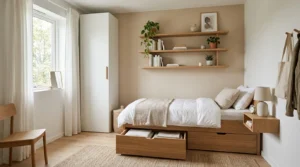
A child’s single bedroom can work well in a smaller space because the furniture is usually smaller. In an 8 × 10 ft room, a single bed, narrow wardrobe, toy storage, and small desk can fit if the layout stays simple.
Good choices include:
- Storage bed
- Wall-mounted shelves
- Compact wardrobe
- Small study desk
- Under bed toy boxes
- Hooks behind the door
The goal is to keep the floor as open as possible. Therefore, storage should go upward or under the bed instead of spreading across the floor.
Best Size for an Adult Single Bedroom
An adult single bedroom needs better storage and more movement space. A room around 9 × 10 ft or larger is more practical because it can fit a single bed, wardrobe, chest of drawers, bedside table, and possibly a compact desk. For adults, comfort depends heavily on clearance. If the wardrobe doors cannot open properly or the bed blocks the main path, the room will feel smaller than it is.
Best Size for a Guest Single Bedroom
A guest single bedroom does not need as much daily storage. Still, it should feel welcoming and easy to use. A single bed, bedside table, small wardrobe, luggage space, and good lighting are usually enough. A daybed can also be a smart option in a guest room. It works as seating when the room is not being used for sleeping, so the space feels more flexible.
Single Bedroom Size in Feet, Meters, Square Feet and Square Meters
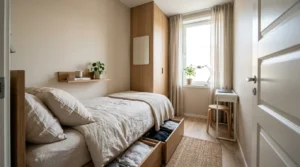
Searchers often want quick conversions, especially when comparing floor plans or buying furniture online. Therefore, it helps to compare single bedroom dimensions in feet, meters, square feet, and square meters.
| Room Size | Square Feet | Square Meters | Practical Use |
|---|---|---|---|
| 7 × 10 ft | 70 sq ft | 6.5 m² | Very tight room, bed only |
| 8 × 10 ft | 80 sq ft | 7.4 m² | Small single bedroom |
| 9 × 10 ft | 90 sq ft | 8.4 m² | Better small single bedroom |
| 10 × 10 ft | 100 sq ft | 9.3 m² | Comfortable single room |
| 10 × 12 ft | 120 sq ft | 11.1 m² | Spacious single bedroom |
A square room is usually easier to furnish than a long narrow room. For instance, a 10 × 10 ft room can be easier to plan than a 7 × 14 ft room, even if both have similar floor area. Width affects bed placement, wardrobe access, desk position, and walking space.
What Furniture Fits in a Single Bedroom?
A single bedroom should not be planned around the bed alone. Instead, the furniture list should guide the room size and layout.
In a compact room, the safest furniture combination is a single bed, narrow wardrobe, and small bedside table. In a more comfortable room, you can add a desk, chair, chest of drawers, or shelving.
| Furniture Item | Good for Small Single Bedroom? | Planning Tip |
|---|---|---|
| Single bed | Yes | Place it along one wall to save space |
| Bedside table | Yes, if narrow | Use a floating shelf in very small rooms |
| Wardrobe | Yes, if compact | Sliding doors help in tight spaces |
| Chest of drawers | Maybe | Check drawer opening space first |
| Desk | Maybe | Place near window or against a clear wall |
| Chair | Only if space allows | Avoid blocking the walkway |
| Wall shelves | Yes | Use vertical wall space |
| Under bed storage | Yes | Great for bedding and seasonal items |
The biggest mistake is choosing furniture that is too deep or too wide. In a small single bedroom, slim furniture is usually better than bulky furniture because it protects the walking path.
Clearance Rules for a Single Bedroom Layout
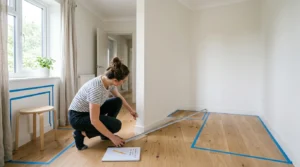
Clearance is the space needed to move around furniture. It is one of the most important parts of bedroom layout planning. A single bedroom should have enough clearance for walking, opening doors, pulling drawers, using a desk chair, and making the bed. Without clearance, even a room with decent square footage can feel frustrating.
Useful clearance targets include:
| Area | Recommended Clearance | Why It Matters |
|---|---|---|
| Main walking side of bed | Around 24 in / 60 cm | Helps with movement and bed making |
| Less used side of bed | Around 18 in / 45 cm | Works in tighter layouts |
| Front of drawers | Around 36 in / 90 cm | Allows drawers to open properly |
| Desk chair area | Around 30 to 36 in / 75 to 90 cm | Allows sitting and pulling chair back |
| Main walkway | Around 24 in / 60 cm | Keeps the room usable |
| Wardrobe access | Depends on door type | Sliding doors need less space |
Door Swing, Wardrobe Doors and Drawer Clearance
Small single bedroom layouts often fail because the door, wardrobe, or drawers were ignored during planning. Before buying furniture, check how every moving part will work.
Ask these questions:
- Can the bedroom door open fully?
- Does the bed block the door?
- Can wardrobe doors open without hitting the bed?
- Can drawers pull out properly?
- Can a desk chair move back without hitting furniture?
- Is there a clear path from the door to the bed?
If the answer is no, the layout needs to change. Otherwise, the room may look fine in photos but feel annoying every day.
Single Bedroom Layout Examples
The right layout depends on the room shape, door position, window placement, and furniture needs. Below are four practical single bedroom layout ideas.
Layout 1: Single Bed Only
This layout is best for a very small single room. Place the bed along the longest wall and use a floating shelf instead of a bedside table. Then, choose under bed storage instead of adding a separate chest of drawers.
Best for:
- Tiny single rooms
- Guest rooms
- Box rooms
- Occasional sleeping spaces
Avoid large bed frames, thick headboards, and heavy storage units. Otherwise, the room will quickly feel overcrowded.
Layout 2: Single Bed and Wardrobe
This is the most common small single bedroom layout. Place the bed against one wall and the wardrobe on the opposite wall or near the door. If the room is narrow, choose a sliding wardrobe or open shelving.
Best for:
- Children’s bedrooms
- Teen bedrooms
- Small adult bedrooms
- Compact rental rooms
A narrow wardrobe can work better than a deep one because it protects the walking path. In addition, lighter furniture can make the room feel less crowded.
Layout 3: Single Bed and Desk
A single bedroom with desk layout is useful for students, teenagers, and people working from home occasionally. Ideally, the desk should sit near natural light, but it should not block the window or radiator.
Best for:
- Student rooms
- Study bedrooms
- Teen bedrooms
- Small work and sleep spaces
Use a narrow desk, wall shelf, or fold-down desk if the room is tight. As a result, the room can support both study and sleep without feeling overloaded.
Layout 4: Single Bed, Wardrobe and Desk
This layout needs more planning. It works best in a 9 × 10 ft or 10 × 10 ft room. Place the bed along one wall, keep the wardrobe in a corner or near the door, and use a compact desk on a clear wall.
Best for:
- Adult single bedrooms
- Student bedrooms
- Teen bedrooms
- Guest room and office hybrids
This setup works only if the furniture is compact and the walkway stays clear. Otherwise, the room will feel like storage space instead of a bedroom.
Layout Mistakes That Make a Single Bedroom Feel Smaller
Avoid these common mistakes:
- Putting the bed where it blocks the door
- Choosing a bed frame much larger than the mattress
- Placing a wardrobe where doors cannot open
- Adding both a dresser and wardrobe in a tiny room
- Using a large desk in a narrow room
- Ignoring window and radiator placement
- Filling every wall with furniture
- Using dark, bulky furniture in a compact space
A small single bedroom does not need more furniture. It needs better furniture.
Is an 8 × 10 ft Room Big Enough for a Single Bedroom?
Yes, an 8 × 10 ft room is usually big enough for a small single bedroom. It gives about 80 square feet, which can fit a single bed and basic storage. However, it may feel tight if you try to include a full wardrobe, large desk, chest of drawers, and chair. It is not the best size for oversized furniture or a double bed. If the room must include a desk and wardrobe, a 9 × 10 ft or 10 × 10 ft room will feel more practical.
Small Single Bedroom Design Tips
Small single bedrooms can feel comfortable if you design them around movement, storage, and light. The aim is to reduce clutter and keep the floor as open as possible.
Use these tips:
- Choose a simple single bed frame
A bulky bed frame can steal several inches from the room. Therefore, pick a slim frame or storage bed. - Use under bed storage
This is one of the easiest ways to reduce the need for extra furniture. - Install wall-mounted shelves
Shelves keep books, decor, and small items off the floor. As a result, the room feels cleaner and more open. - Choose sliding wardrobe doors
Sliding doors save space because they do not swing outward. - Use a floating bedside shelf
This replaces a bedside table in a very small room. - Keep colors light and calm
Light walls can make a small bedroom feel more open. - Add a mirror carefully
A mirror can reflect light and make the room feel larger. However, it should not create visual clutter. - Avoid too much furniture
A bed, wardrobe, and small desk may be enough. - Use vertical storage
Tall narrow storage is often better than wide low storage. - Keep the walkway clear
A clear path makes the room feel bigger and easier to use.
Best Storage Ideas for a Small Single Bedroom
Storage decides whether a small room feels peaceful or messy. Good storage ideas include:
- Storage bed
- Under bed drawers
- Wall shelves
- Over door hooks
- Tall narrow wardrobe
- Fold down desk
- Floating bedside shelf
- Built-in wardrobe
- Storage bench
- Drawer dividers
If the room is very small, avoid adding too many freestanding pieces. One smart storage bed can be better than a bed plus a chest of drawers.
FAQs
What is the standard single bedroom size?
The usual size is around 7.5 to 10 square meters, or 80 to 108 square feet. A smaller room can work, but a larger room gives better space for storage, desk use, and movement.
What is the minimum size for a single bedroom?
A useful minimum reference is around 7.5 square meters, or about 80.7 square feet. However, local planning, rental, and building rules can vary, so always check the rules that apply to your location.
Is 7.5 m² enough for a single bedroom?
Yes, 7.5 m² can be enough for a compact single bedroom, especially with a single bed and basic storage. Still, it may feel tight if you add a desk, large wardrobe, or chest of drawers.
Can a single bedroom fit a desk and wardrobe?
Yes, but the room should ideally be closer to 9 × 10 ft or larger. In a smaller room, use a narrow desk, sliding wardrobe, wall shelves, and under-bed storage.
Conclusion
The right single bedroom size depends on more than the bed. A compact room around 7.5 square meters can work as a minimum, while 8 to 10 square meters is usually more comfortable for daily use. An 8 × 10 ft room can function well with a single bed and basic storage, but a 9 × 10 ft or 10 × 10 ft room gives better flexibility.
To plan the room properly, measure the bed, wardrobe, drawers, door swing, desk space, and walking path. The best standard single bedroom size is not always the largest option. Instead, it is the size that allows clear movement, smart storage, and furniture that fits the room naturally.


Leave a Reply