


Choosing the right bed is one of the most significant investments you can make for your home and your everyday health. A mattress that is too small can leave you feeling cramped, whereas a frame that is too large can swallow your bedroom whole. As a result, understanding exact king size bed dimensions before purchasing ensures that your setup balances personal sleeping comfort with functional floor space.
In North America, standard king size bed dimensions measure 76 inches wide by 80 inches long. In feet and inches, this translates to 6 feet 4 inches wide by 6 feet 8 inches long, giving you an expansive total surface area of 6,080 square inches. When converted to the metric system, these standard king bed dimensions equal approximately 193 centimetres wide by 203 centimetres long, or 1930 millimetres by 2032 millimetres. Consequently, this footprint provides each sleeper with 38 inches of dedicated width, which is the exact equivalent of having an individual twin bed all to yourself.
Master King Size Bed Dimension Chart
To help you visualize how different styles compare across imperial and metric standards, the table below highlights standard measurements alongside recommended space allocations for major bed styles.
| Bed Model and Region | Dimensions in Inches | Dimensions in Feet and Inches | Dimensions in Centimetres | Minimum Recommended Room Size |
| US Standard King (Eastern King) | 76 in by 80 in | 6 ft 4 in by 6 ft 8 in | 193 cm by 203 cm | 12 ft by 12 ft (3.6 m by 3.6 m) |
| US California King (Western King) | 72 in by 84 in | 6 ft 0 in by 7 ft 0 in | 183 cm by 213 cm | 12 ft by 14 ft (3.6 m by 4.2 m) |
| US Split King (Two Twin XLs) | 76 in by 80 in | 6 ft 4 in by 6 ft 8 in | 193 cm by 203 cm | 12 ft by 12 ft (3.6 m by 3.6 m) |
| UK and Ireland King | 60 in by 78.7 in | 5 ft 0 in by 6 ft 6 in | 150 cm by 200 cm | 10 ft by 11 ft (3.0 m by 3.3 m) |
| UK and Ireland Super King | 71 in by 78.7 in | 6 ft 0 in by 6 ft 6 in | 180 cm by 200 cm | 12 ft by 12 ft (3.6 m by 3.6 m) |
| European King Size | 63 in by 78.7 in | 5 ft 3 in by 6 ft 6 in | 160 cm by 200 cm | 11 ft by 11 ft (3.3 m by 3.3 m) |
| Australian King | 72 in by 80 in | 6 ft 0 in by 6 ft 8 in | 183 cm by 203 cm | 12 ft by 12 ft (3.6 m by 3.6 m) |
| Wyoming King | 84 in by 84 in | 7 ft 0 in by 7 ft 0 in | 213 cm by 213 cm | 14 ft by 14 ft (4.2 m by 4.2 m) |
| Texas King | 80 in by 98 in | 6 ft 8 in by 8 ft 2 in | 203 cm by 249 cm | 14 ft by 16 ft (4.2 m by 4.8 m) |
| Alaskan King | 108 in by 108 in | 9 ft 0 in by 9 ft 0 in | 274 cm by 274 cm | 16 ft by 16 ft (4.8 m by 4.8 m) |
Standard King vs. Alternative King Variants
When shopping for an expansive bed, you will encounter several styles that carry the king label. While they share generous sleeping areas, their physical proportions serve very different needs.
Standard King (Eastern King) vs. California King
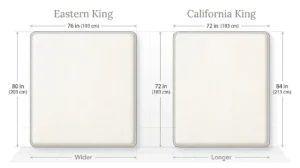
The standard king, frequently labeled an Eastern king in retail stores, emphasizes generous width. At 76 inches wide and 80 inches long, it is built for couples, restless sleepers who change positions through the night, and households that welcome children or pets into bed on weekend mornings.
In contrast, the California king, often termed a Western king, shifts four inches of width into extra length. Measuring 72 inches wide by 84 inches long, it is the premier choice for people taller than 6 feet 2 inches who find their feet hanging off standard mattresses. In addition, the California king is well suited for long, narrow master bedrooms where an extra-wide frame might block bedside traffic paths.
Split King Setups and Dual-Adjustable Bases
A split king mattress features identical outer measurements to a standard king, totaling 76 inches by 80 inches. However, it consists of two separate Twin XL mattresses placed side by side, each measuring 38 inches by 80 inches.
Furthermore, this design is popular for couples with contrasting sleep preferences. One partner can select an ultra-firm hybrid mattress while the other chooses plush memory foam. When paired with an independent adjustable power base, split king designs let one person elevate their head to read or alleviate snoring without disturbing the sleeper beside them. Keep in mind that split king beds require specialized bedding, specifically two separate Twin XL fitted sheets paired with a single king size flat sheet or duvet.
Mattress Dimensions vs. Actual Bed Frame Footprint
One of the most frequent missteps buyers make is measuring their bedroom exclusively against bare mattress dimensions. While a standard mattress is 76 inches by 80 inches, the actual bed frame will always command more floor area.

-
Minimalist Platform and Metal Frames: These streamlined designs hug the mattress closely, typically adding only half an inch to two inches along the perimeter. Therefore, they are ideal for compact rooms where every inch counts.
-
Solid Wood Frames and Panel Beds: A solid wooden king size bed frame typically adds two to four inches along the sides and headboard, requiring around 78 to 80 inches of width and 82 to 84 inches of length.
-
Upholstered and Wingback Frames: Padded fabrics and tufted rails add significant volume, often extending the outer perimeter by four to six inches.
-
Sleigh Beds and Storage Frames: Traditional sleigh beds with curved scrolls can easily add up to ten inches to the total length, turning an 80-inch mattress into an 90-inch architectural centerpiece.
Mattress Thickness and Entry Height
Mattress depth also dictates how your bed interacts with the room. Standard mattresses measure between 10 and 12 inches deep, while premium pillow-top and latex options can reach 14 to 18 inches. When you combine a high-profile mattress with a traditional nine-inch box spring and an elevated frame, the top surface can sit nearly 30 inches off the floor. An ergonomic total bed height from floor to top of mattress is between 20 and 24 inches, allowing your feet to rest flat on the floor when seated on the edge.
Room Layout Planning and Practical Clearances
A primary question many homeowners ask is what room size do you need for a king bed. While you can technically squeeze standard king size bed dimensions into a 10 foot by 10 foot room, the space will feel claustrophobic once you install nightstands and dressers.
The gold standard for a standard king is a bedroom measuring at least 12 feet by 12 feet (144 square feet). If you plan to incorporate an expansive master bedroom suite with matching nightstands, a six-drawer dresser, a television armoire, and an accent reading chair, a 13 foot by 14 foot or 14 foot by 14 foot layout is much more comfortable.
The Walkway Clearance Rule
Interior designers emphasize maintaining at least 30 to 36 inches of clear walking space around the perimeter of the bed. This clearance ensures that you can walk comfortably on both sides without bumping into walls, vacuum easily, and make the bed without straining your back.
Be sure to account for operational clearances as well:
-
Wardrobe and closet doors must swing open without striking the bed frame.
-
Nightstand drawers should pull out fully without colliding with side rails.
-
Low-profile windows should not be obscured by high headboards.
If you plan to place an area rug under your bed, select an 8 foot by 10 foot or 9 foot by 12 foot rug. This allows the rug to extend at least two to three feet beyond the edges and footboard, providing a warm, balanced surface underfoot.
Weight Capacity and Structural Support Requirements
A standard king bed holds substantial mass, making proper foundational support essential. A king mattress made with dense latex or heavy pocketed coils weighs between 120 and 180 pounds on its own. When you add a quality bed frame, two adult sleepers, and potential visits from children or pets, total distributed weight often exceeds 600 to 800 pounds.
Because of the broad 76-inch span, a king bed frame must feature heavy-duty center support. Never rely on horizontal wooden slats that span the entire width without reinforcement. Quality king frames incorporate a rigid center support beam fitted with at least one to three vertical support legs resting securely on the floor. Without this center spine, wooden slats will bow downward over time, creating a noticeable depression in your mattress and potentially voiding its manufacturer warranty.
Delivery Logistics and Navigation Hurdles
Before ordering your dream bed, trace the delivery pathway from your front curb all the way to your bedroom. King size mattresses are notoriously cumbersome to maneuver through tight spaces.

-
Entryways and Doorways: Standard residential interior doors are usually 30 to 32 inches wide. If your hallway requires a tight ninety-degree turn immediately after a door, navigating a rigid king mattress can be challenging.
-
Staircase Switchbacks: Low bulkheads and sharp staircase landings are the leading causes of delivery failures. Measure the diagonal clearance and vertical ceiling height along the entire stair run.
-
Box Springs: Traditional one-piece king box springs cannot make sharp corners in residential stairwells. For this reason, all standard king box springs are manufactured as split foundations, meaning you receive two separate 38-inch by 80-inch foundations that sit side by side beneath the mattress.
-
Bed-in-a-Box Convenience: Modern foam and hybrid mattresses vacuum-compressed into shipping boxes bypass many stairwell obstacles. Once unboxed inside the master bedroom, they expand to full dimensions within 24 to 48 hours.
International Sizing Variations and Terminology Traps
Bed sizing varies considerably by geographical market. Assuming terms are universal can lead to expensive shipping mistakes and mismatched linens.
In the United Kingdom, a standard king size bed measures 150 centimetres wide by 200 centimetres long (approximately 60 inches by 78.7 inches). This means a UK king is nearly identical to an American queen size mattress. If you want the spacious equivalent of an American king in the UK, you must look for a UK super king, which measures 180 centimetres by 200 centimetres (about 71 inches by 78.7 inches).
In mainland Europe, king beds generally adhere to standard European sizing of 160 centimetres by 200 centimetres (63 inches by 78.7 inches), often called an Euro king. Australian king beds measure 183 centimetres by 203 centimetres (72 inches by 80 inches), matching the width of a California king with the length of a standard American king. Always double-check your frame origin before ordering sheets, duvets, or mattress pads online.
Oversized King Beds: Wyoming, Texas, and Alaskan Kings
For homeowners with expansive master suites, standard king size bed dimensions may not provide enough presence. In recent years, oversized specialty mattresses have gained popularity among family co-sleepers and luxury homeowners.
-
Wyoming King: Measures 84 inches wide by 84 inches long (7 feet by 7 feet). This square layout gives you the added length of a California king along with an extra foot of side-to-side width. It requires a room measuring at least 14 feet by 14 feet.
-
Texas King: Measures 80 inches wide by 98 inches long (6 feet 8 inches by 8 feet 2 inches). Narrower than an Alaskan king but exceptionally long, it is designed for tall individuals with expansive master bedrooms.
-
Alaskan King: Measures 108 inches wide by 108 inches long (9 feet by 9 feet). The ultimate luxury statement, this bed comfortably accommodates two adults, several children, and pets simultaneously. It requires a grand master bedroom of at least 16 feet by 16 feet and custom-tailored bedding.
Ownership Trade-Offs and Long-Term Care
While a spacious king bed transforms your sleeping routine, it comes with practical daily trade-offs worth noting:
-
Center Ridge Formation: In two-sleeper households, individuals typically sleep on their respective sides, leaving the middle unoccupied. Over months of use, the perimeter cushions compress while the center remains untouched, creating a slight raised center ridge. Rotate your mattress 180 degrees every three to six months to promote even wear.
-
Bedding Expenses: King duvets, sheet sets, and mattress protectors carry a price premium over queen sets. Furthermore, fitted sheets with extra-deep pockets (15 to 18 inches) are necessary if you use a high-profile pillow-top mattress.
-
Handling and Housekeeping: Making a king bed requires more physical effort, as fitting tucked sheets across a 76-inch span involves circling the bed multiple times. The weight of heavy latex or multi-layer foam mattresses also makes lifting corners a demanding task.
FAQs
Can a king size bed fit comfortably in a 10 by 10 bedroom?
Technically, standard king size bed dimensions occupy roughly 42 square feet of floor space, leaving around 58 square feet in a 10 by 10 foot room. However, after accounting for a headboard and frame, you will only have about two feet of clearance on either side, leaving virtually no functional space for nightstands, wardrobes, or open door swings. Therefore, a 12 by 12 foot room is the practical minimum.
How much wider is a king than a queen size bed?
A standard king mattress is 76 inches wide, whereas a standard queen mattress is 60 inches wide. As a result, a king provides an additional 16 inches of personal space, giving each sleeper eight inches of extra width to spread out comfortably.
Are king and California king sheets interchangeable?
No, they are not interchangeable. Standard king sheets are designed for a mattress measuring 76 inches wide by 80 inches long, whereas a California king is 72 inches wide by 84 inches long. Consequently, a standard king fitted sheet will be too loose along the sides and too short to hook over the corners of a California king, causing the elastic corners to snap off during the night.
Do two twin beds make a king?
Not standard twin beds. Two regular twin beds placed together measure 76 inches wide by 75 inches long, which is five inches shorter than a standard king. However, to create a true standard king surface of 76 inches by 80 inches, you must use two Twin XL (extra long) mattresses, which measure 38 inches wide by 80 inches long each.
What size duvet should I purchase for a standard king?
To ensure proper coverage and an attractive drape over the sides of the mattress, choose a king size duvet measuring between 104 and 108 inches wide by 90 to 96 inches long. In addition, if you sleep on a luxury high-profile mattress with a deep box spring, opt for the 108-inch width to prevent your sheets or side rails from showing.





Leave a Reply