

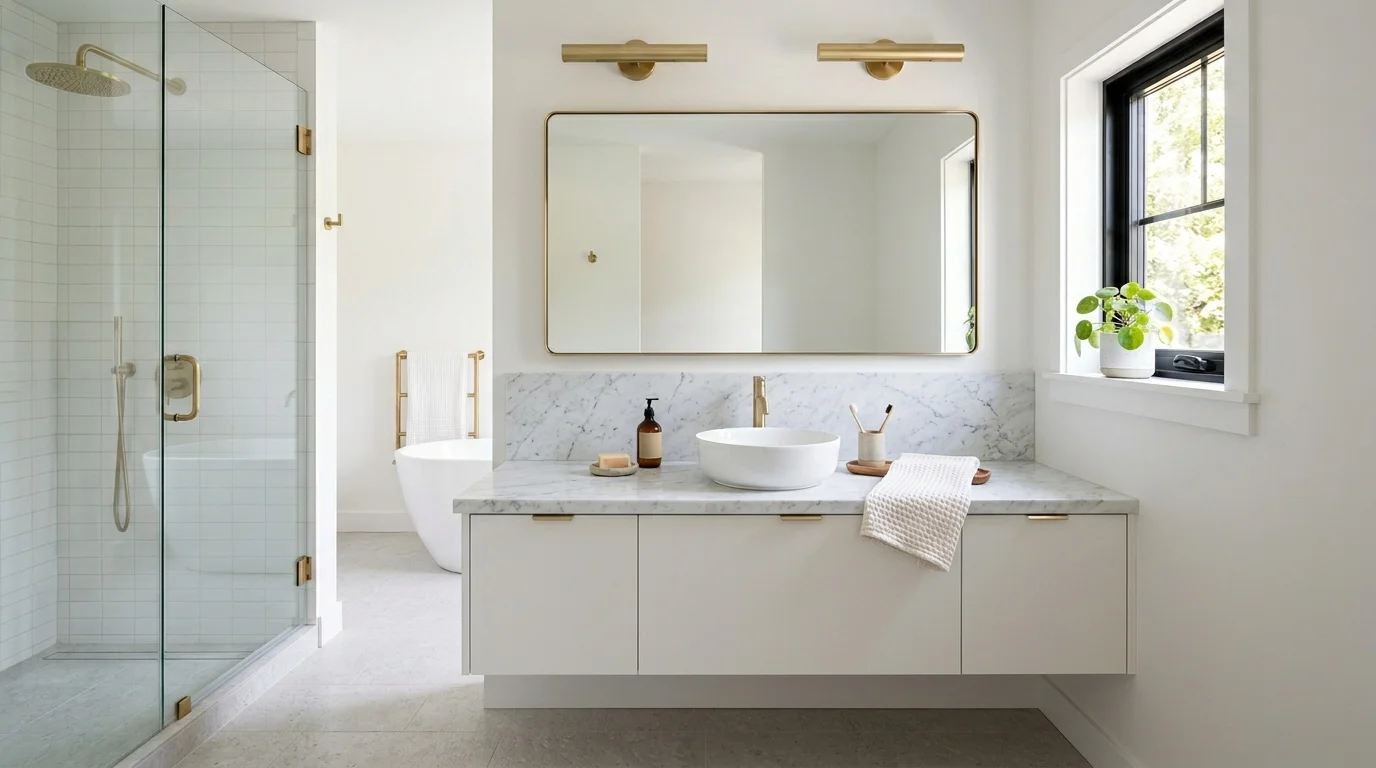
Choosing white bathroom paint colors sounds easy until you start comparing samples. One white looks fresh and clean, another looks yellow, another turns gray, and another feels too cold once it is on the wall. Bathrooms make this decision even harder because the paint sits beside tile, grout, mirrors, vanities, sinks, tubs, toilets, countertops, and metal fixtures. All of these surfaces can change the way white paint appears.
The best white bathroom paint colors are not chosen from a paint chip alone. They are chosen by looking at undertones, lighting, room size, bathroom materials, and the type of finish you need. A white that looks beautiful in a sunny bedroom may look flat in a windowless bathroom. A creamy white that feels soft in a living room may look yellow beside bright white tile or porcelain.
This guide will help you choose the right white paint for bathroom walls without making the space look sterile, dull, or mismatched.
Why White Paint Works So Well in Bathrooms
White is one of the most popular bathroom wall colors because it makes a space feel clean, open, and timeless. It reflects light, which can make a small bathroom feel larger and a dark bathroom feel brighter. White also works with many design styles, including modern, farmhouse, traditional, coastal, minimalist, and spa-inspired bathrooms.
The problem is that white is rarely just white. Most white paint colors have undertones. Some lean warm with cream, beige, yellow, or greige notes. Others lean cool with gray, blue, green, or violet notes. Some sit closer to neutral and work well when the bathroom has mixed materials.
This is why the goal is not to find the brightest white. The goal is to find the right white for your bathroom.
Best White Bathroom Paint Colors for Different Bathroom Styles
For a modern bathroom, crisp white paint usually works best. Shades like Benjamin Moore Chantilly Lace, Sherwin-Williams Pure White, Sherwin-Williams Extra White, and Behr Ultra Pure White can create a sharp, clean look, especially with black fixtures, chrome hardware, glass shower doors, and simple tile.
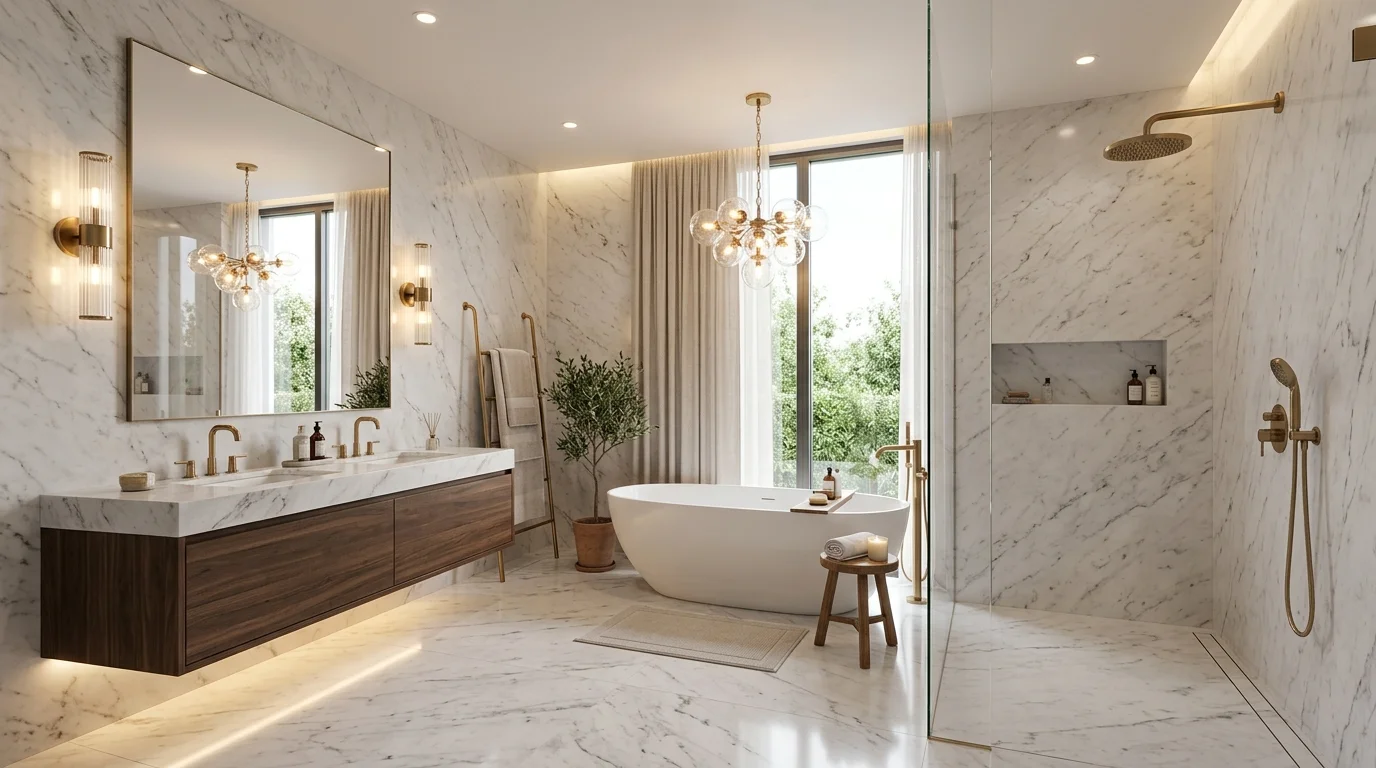
For a traditional bathroom, softer whites usually feel more natural. Benjamin Moore White Dove, Benjamin Moore Swiss Coffee, Sherwin-Williams Alabaster, and Farrow & Ball Pointing can add warmth without making the bathroom feel outdated. These colors pair well with brass fixtures, polished nickel, wood vanities, marble countertops, and classic tile.
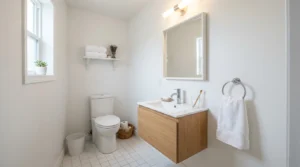
For a spa-like bathroom, choose a soft white or neutral white rather than a bright clinical white. The space should feel calm, not harsh. Sherwin-Williams Snowbound, Behr Whisper White, Benjamin Moore Simply White, and White Dove are strong options because they create brightness while still feeling relaxed.
For farmhouse bathrooms, creamy white bathroom paint often works better than a cold white. Alabaster, Shoji White, Swiss Coffee, and Pointing are good choices because they pair well with wood, black hardware, warm tile, shiplap, and natural textures.
Warm White, Cool White, and Neutral White
Warm white bathroom paint is best when the bathroom has warm materials. If your space includes beige tile, cream flooring, brass fixtures, gold hardware, wood vanities, or warm lighting, a warm white can make the room feel soft and connected. White Dove, Swiss Coffee, Alabaster, Shoji White, and Behr Polar Bear are good examples.
Cool white bathroom paint works better with gray tile, marble, chrome, polished nickel, black fixtures, and blue-gray accents. Cool whites create a fresh and polished look, but they can feel cold if the room has no natural light. Chantilly Lace, Decorator’s White, Super White, Extra White, and Behr Frost are useful choices for this style.
Neutral white bathroom paint is the safest option when the bathroom has mixed finishes. If you have white subway tile, black hardware, a wood vanity, and a gray countertop, a neutral white can help balance everything. Pure White, Snowbound, Simply White, Whisper White, and Painter’s White can work well in bathrooms where warm or cool whites feel too extreme.
Best White Paint for Small Bathrooms
When choosing white bathroom paint colors for a small room, do not automatically choose the brightest shade. Very bright white can sometimes make a small bathroom feel sharp or unfinished, especially if the space has strong lighting, glossy tile, and large mirrors.
A soft neutral white usually works better. Sherwin-Williams Pure White is a strong choice because it feels clean without being too cold. Benjamin Moore White Dove can make a small bathroom feel softer and warmer. Simply White can brighten the room while still giving a classic look. Snowbound is useful when the bathroom has gray tile or modern finishes.
For a small bathroom, you can also paint the walls, trim, and ceiling in the same white but use different finishes. This reduces visual breaks and makes the space feel larger. For example, use eggshell or satin on the walls, semi-gloss on the trim, and matte or flat paint on the ceiling.
Best White Paint for Windowless Bathrooms
A windowless bathroom needs extra care because artificial light controls everything. A white that looks clean in daylight may look yellow, gray, or blue under vanity lights. This is why the best white paint for a windowless bathroom is usually warm or neutral, not icy.
White Dove, Swiss Coffee, Shoji White, Polar Bear, Whisper White, and Pure White are good starting points. These shades can help the room feel brighter without becoming too harsh. If your bathroom bulbs are very cool, avoid blue-based whites because they may make the walls feel cold. If your bulbs are very warm, be careful with creamy whites because they may look more yellow than expected.
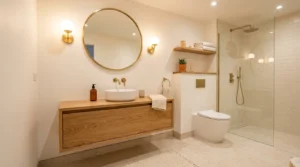
Before painting the full room, test samples under the exact lights you use every day. Check the color in the morning, afternoon, and night if the bathroom gets any indirect light. If it has no window at all, judge the paint only under your real vanity and ceiling lighting.
Choosing White Paint for Tile, Marble, and Fixtures
Tile is one of the biggest reasons white paint goes wrong in bathrooms. White tile is not always pure white. It can be creamy, gray, blue-white, warm, or bright porcelain white. If your paint is much creamier than your tile, it may look yellow. If your paint is much cooler than your tile, the tile may look dirty or old.
For bathrooms with white subway tile, neutral whites are usually safest. Pure White, Simply White, White Dove, Snowbound, and Whisper White are strong options. Always test the paint beside the tile and grout before choosing.
For marble bathrooms, look closely at the veining. If the marble has gray or blue-gray veining, cool whites such as Chantilly Lace, Decorator’s White, Snowbound, and Frost can work well. If the marble has warm beige or taupe veining, White Dove or Swiss Coffee may look more balanced.
For gray tile, avoid very creamy whites unless the gray has warm undertones. Cool or neutral whites usually look cleaner. For beige tile, avoid icy whites because they can make the tile look dull. Warm whites such as Alabaster, Shoji White, Swiss Coffee, and Pointing are usually better.
Fixtures matter too. Brass and gold fixtures usually look best with warm whites. Chrome works well with cool whites. Black fixtures look sharp against crisp neutral whites. Polished nickel is more flexible and can work with warm, cool, or neutral whites depending on the rest of the bathroom.
Best Finish for White Bathroom Paint
The bathroom paint finish matters almost as much as the color. White paint reflects light, so the wrong sheen can make the walls look too shiny, uneven, or flat.
Eggshell is a good finish for many bathroom walls because it has a soft look and is easier to clean than flat paint. Satin is better for high-use bathrooms because it handles moisture and cleaning better, but it reflects more light. Semi-gloss works well for trim, doors, and vanities because it is durable and easy to wipe down. Matte or flat paint is usually best for ceilings, but in bathrooms you should choose a moisture-resistant formula.
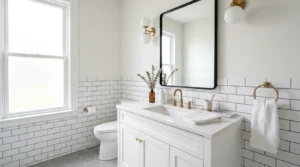
If the bathroom is used daily, satin may be the safer wall finish. If it is a powder room or guest bathroom with less moisture, eggshell can look more refined. For white trim, semi-gloss is still a reliable choice.
Common Mistakes to Avoid When Choosing White Paint
The biggest mistake is choosing a paint color because it looked good in someone else’s bathroom. Photos are affected by editing, camera exposure, lighting, and surrounding materials. Your bathroom has its own tile, fixtures, flooring, and light.
Another mistake is ignoring the tub, sink, and toilet. These are usually bright white porcelain, and they can make creamy off-white bathroom paint colors look more yellow. Always test samples beside these fixed surfaces.
Many people also forget about bulb temperature. Warm bulbs can make white paint look creamier, while cool bulbs can make it look blue or gray. If your vanity lights and ceiling lights use different bulb temperatures, the paint may look different across the room.
The final mistake is using the same white everywhere without checking the finish. A white in satin can look different from the same white in semi-gloss. This matters on walls, trim, cabinets, and ceilings.
How to Test White Paint Before Painting
Testing is not optional if you want the result to look professional. Choose at least three samples and place them near your tile, vanity, countertop, tub, sink, toilet, and fixtures. Look at them during different times of day and under your bathroom lights at night.
Do not test the paint on a tiny patch hidden in a corner. Put the sample where you can see it beside the main materials in the bathroom. A white that looks good on an empty wall may look wrong once it is beside tile or porcelain.
Give yourself at least 48 hours before deciding. The best sample is the one that still looks clean, balanced, and natural after you have seen it in all lighting conditions.
When White Is Not the Best Choice
White is classic, but it is not always the right answer. If every white sample looks too stark, too yellow, or too gray, the bathroom may need a softer neutral instead. Pale greige, warm cream, misty blue, soft sage, light taupe, or pale gray can still make a bathroom feel bright while adding more depth.
This is especially true in bathrooms with older beige tile, harsh lighting, or very cold finishes. Forcing a crisp white into the wrong room can make the space feel unfinished. A softer color may create a better result.
Final Thoughts
The best white bathroom paint colors are the ones that work with your actual bathroom, not just with a trend or online photo. Look at undertone, lighting, tile, grout, porcelain, fixtures, room size, and finish before choosing.
Use warm white for brass, beige tile, wood vanities, and low-light bathrooms. Use cool white for marble, gray tile, chrome, and modern bathrooms. Use neutral white when you want flexibility and a clean look that is easier to pair with mixed materials.
If you want the safest path, start with White Dove, Pure White, Simply White, Snowbound, Whisper White, or Chantilly Lace, then test them in your bathroom for at least 48 hours. The right white should make the room feel clean, bright, and calm without looking yellow, gray, blue, or sterile.


Leave a Reply